Ecosystem-Based Adaptation Takes Center Stage at COP30 in Belém do Pará
During COP30, Guatemala, Costa Rica, and Ecuador led a session on the importance of Ecosystem-Based Adaptation measures in meeting each country’s climate goals, as well as the actions they’ve taken to get there.

© Ministry of Environment and Natural Resources of Guatemala
During a day of climate diplomacy at the highest-level global summit in Belém do Pará, Guatemala, Costa Rica, and Ecuador positioned ecosystem-based adaptation as a cornerstone of efforts to confront the impacts of the climate crisis.
The event was led by the Vice Ministry of Natural Resources and Climate Change of Guatemala’s Ministry of Environment and Natural Resources (MARN, for its acronym in Spanish) and the German Development Cooperation (GIZ, for its acronym in German), under the program “Scaling Ecosystem-Based Adaptation (EbA) Measures in Rural Latin America” (EbA-LAC), with support from the International Institute for Sustainable Development (IISD).
“With regional collaboration, knowledge exchange, and innovative financing mechanisms, we have an opportunity to scale nature-based solutions,” noted Dr. Edwin Castellano, Vice Minister of Natural Resources and Climate Change at MARN.
© Ministry of Environment and Natural Resources of Guatemala
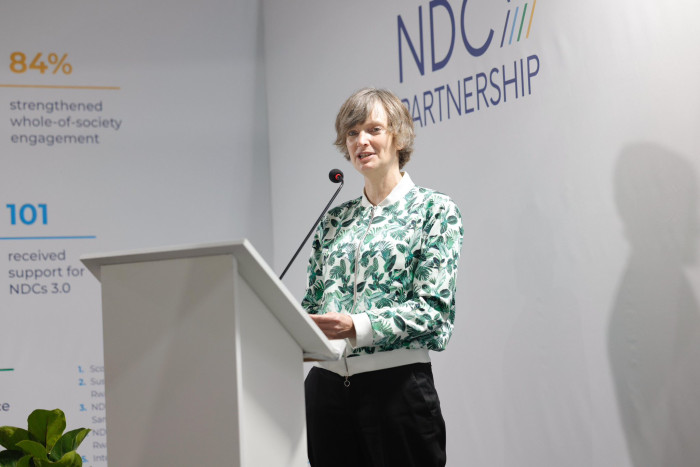
Dr. Eva Kracht, Director General for International and European Policy at Germany’s Federal Ministry for the Environment, Climate Action, Nature Conservation and Nuclear Safety (BMUKN, for its acronym in German), emphasized that in addition to the direct adaptation benefits of EbA measures, these also provide alternative income sources through ecosystem services, thus enhancing the quality of life for people who are most vulnerable to the impacts of climate change.
The event included a panel focused on: “How Can Ecosystem-Based Adaptation (EbA) Initiatives Be Scaled into Policies, Financial Instruments, and Sustainable Production Practices?” Representatives from Costa Rica, Guatemala, and Ecuador discussed their countries’ efforts to achieve this. Costa Rica shared its efforts in integrating EbA into payments for ecosystem services and identifying the need to advance toward effective monitoring, evaluation, and learning (MEL) mechanisms. Guatemala highlighted its plans to strengthen evaluation methods and continue working toward better intersectoral coordination. Ecuador, for its part, will pursue more ambitious goals centered around water security.
Dr. Astrid Michels, Director of the regional EbA-LAC program, underscored that promoting EbA measures at the local level is essential for updating NDC 3.0, so countries can adopt more ambitious targets under the Paris Agreement and align with other international commitments such as the Global Biodiversity Framework.
EbA-LAC is financed by Germany’s Federal Ministry for the Environment, Climate Action, Nature Conservation and Nuclear Safety (BMUKN) through its International Climate Initiative (IKI, for its acronym in German), and has supported the three countries in implementing EbA measures with the aim of strengthening the alignment of public policy with their NDCs, NAPs, and NBSAPs. The program also seeks to generate scientific evidence, develop effective financing mechanisms, and foster cooperation among countries in the region. In addition, it has promoted a multi-level governance approach that encourages participation from women, Indigenous peoples, and youth to ensure the long-term sustainability of climate action and biodiversity conservation.
- Country: Costa Rica, Guatemala
- Project:
- Contact:
Persona de contacto