Mobilizing Sustainable Finance in Latin America and the Caribbean: Key Lessons from IKI Projects
How can sustainable finance be mobilized in Latin America and the Caribbean when capital exists but is not always well directed? This article brings together the main lessons from the regional IKI workshop, which explored how to redirect flows, strengthen capacities, and scale climate action through networked collaboration.
© IKI LAC
Closing the financing gap for climate action and biodiversity conservation has become a central pillar of global climate governance, with increasingly clear implications for regional and national efforts.
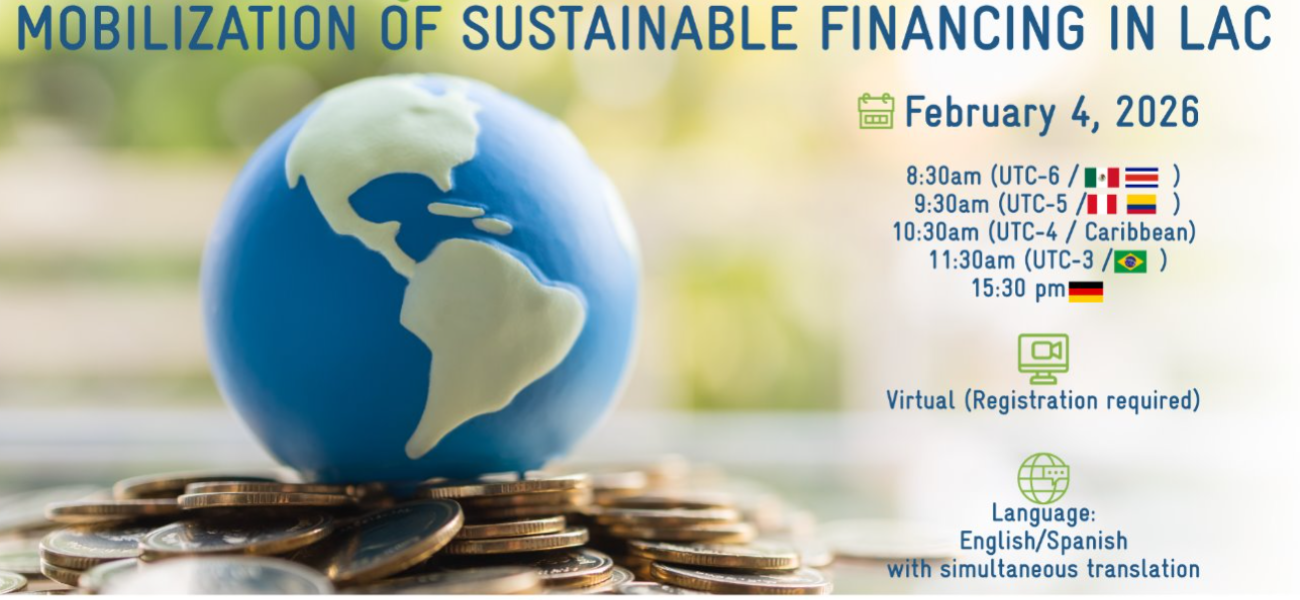
In this context, the virtual regional workshop, “Mobilizing Sustainable Finance in Latin America and the Caribbean”, took place on February 4, 2026. It was organized by the interface projects of the International Climate Initiative (IKI, from its acronym in German) in Mexico, Brazil, Costa Rica (which covers Central America and the Caribbean), Colombia, and Peru. The event brought together IKI projects, financial actors, and representatives of international cooperation, with the goal of exchanging concrete experiences and reflecting on how to translate global debates into operational financial mechanisms in the region.
During the event’s opening, Sören Kirstein, Director of the IKI Interface project in Colombia, emphasized that mobilizing sustainable finance has become a cross-cutting pillar in climate cooperation, and highlighted the importance of exchange among projects to identify effective approaches and generate synergies at the regional level. In this context, the role of interface projects in the 14 IKI focus countries is key, as they facilitate exchange among projects.
This perspective was complemented by Till Tibbe, policy advisor at the International Climate Initiative Division of the German Federal Ministry for the Environment, Climate Action, Nature Conservation and Nuclear Safety (BMUKN, from its acronym in German). He highlighted the IKI 2030 Strategy, which sets clear targets to strengthen enabling environments, to scale up the implementation of climate and biodiversity measures, and to mobilize at least €1.5 billion in private capital in partner countries. He also presented several best practices from the IKI portfolio for mobilizing and catalyzing financial resources.
One of the most compelling messages of the event came from the financial sector. In his address, Markus Müller, Director of Sustainable Investments at Deutsche Bank, offered a key reflection for the current debate, noting that while resources are available, the principal challenge lies in the direction they are taking, and that good intentions alone are not enough.
This statement highlighted one of the principal challenges of mobilizing sustainable finance: available capital is not always aligned with climate and biodiversity goals. To make progress in this area, a combination of clear regulatory frameworks, appropriate financial instruments, and projects capable of effectively absorbing investment is required.
From the perspective of IKI projects, the workshop demonstrated how these challenges are being addressed in practice. Ana Orozco, an Environmental Finance Specialist at UNDP and representative of the IKI BIOFIN (Biodiversity Finance Initiative) project, emphasized the need to rethink existing financial flows, and explained that the BIOFIN conceptual model begins by identifying the real financing needs required to achieve systemic transformations and uses a robust methodology to develop financing plans that help close the existing gap and redirect flows. BIOFIN currently operates in 133 countries, demonstrating the potential of this approach to scale positive financial solutions for biodiversity.
The role of blended finance was another central theme of the event. Drawing on the experience of the IKI-LAC Climate Private Sector Mobilization Fund, Paola Pedroza, Director of Blended Finance at IDB Invest, highlighted the importance of leveraging existing financial tools to attract the private sector to sustainable development projects in the region.
Pedroza emphasized that these mechanisms help reduce risks, improve investment conditions, and build trust, which has made it possible to significantly scale the mobilized resources. The message was clear: when financial design is appropriate, private capital does respond.
The workshop also included participation from the IKI LACADI (Latin American Climate Asset Disclosure Initiative) project, represented by Mariana Rojas Laserna, Director of Climate Finance at Transforma, who shared experiences on integrating risks and climate opportunities into the Latin American financial system. She highlighted the importance of strengthening technical capacities and disclosure frameworks as a foundation for mobilizing sustainable finance.
The IKI FAST (Fast-tracking Transformation through Sustainable Public Finance for Biodiversity) project, through Christine Majowski, Director of Sustainable Finance Projects at GIZ Brazil, discussed how sustainable public finance can help achieve climate and biodiversity goals. It also addressed the importance of aligning fiscal and budgetary instruments to transform financial flows in the region.
In addition to the presentations, the workshop included a participatory exercise in which the projects shared their firsthand experiences in mobilizing sustainable finance. The responses showed that the principal obstacles are not necessarily a lack of capital, but rather structural factors, such as:
- the perception of high risk by the financial sector,
- the absence or weakness of adequate financial instruments, and
- the lack of technical capacity, information, and sufficiently structured projects to access financing.
At the same time, the projects agreed that the most relevant conditions for strengthening resource mobilization include clear and stable regulatory frameworks, blended finance schemes, ongoing technical assistance, and spaces for collaboration between public and private actors.
At the close of the event, Miriam Velasco, Director of the IKI Interface Project in Peru, highlighted the importance of investing in knowledge generation and promotion, as well as strengthening the IKI community as an active network capable of connecting projects, sharing lessons learned, and building collective solutions beyond isolated interventions. The final message was clear: mobilizing sustainable finance is a long-term process that requires community, trust, and ongoing cooperation. In this sense, the workshop not only facilitated the exchange of experiences but also reinforced a shared vision on how to move forward in a coordinated manner in scaling climate action and biodiversity conservation in Latin America and the Caribbean.
- Country: Antigua and Barbuda, Bahamas, Barbados, Belize, Costa Rica, Cuba, Dominica, El Salvador, Global, Grenada, Guatemala, Guyana, Haití, Honduras, Jamaica, Nicaragua, Panama, Dominican Republic, Saint Kitts and Nevis, Saint Vincent and Grenadines, Saint Lucia, Suriname, Trinidad and Tobago
- Contact:
Ann-Kathrin Schloenvoigt