Biological Connectivity is at the Center of New Strategy for Pollinator Conservation in the Nicoya Peninsula
Twenty-four families and two biological corridors will be the leading examples of pollinator-friendly practices in the Nicoya Peninsula region of the Guanacaste and Puntarenas provinces in Costa Rica.
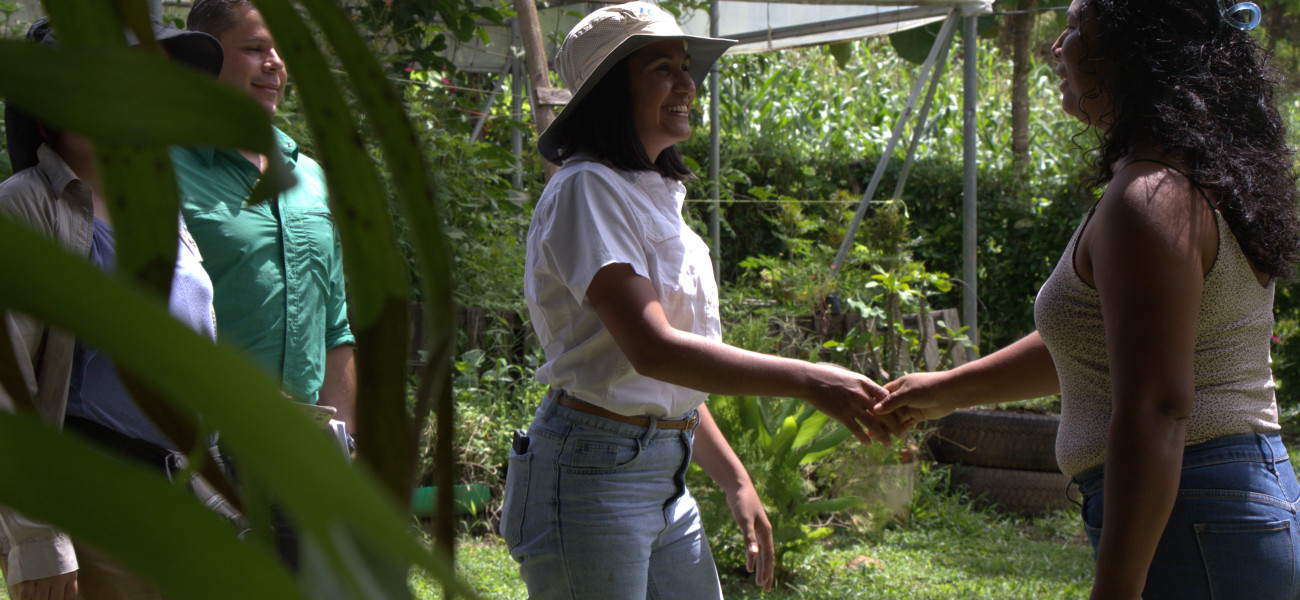
Mildred welcomes local attaché for the program in her organic farm in the community of Matambú in the Nicoya Peninsula. © GIZ
Every day in the town of Matambú, Mildred works on her organic farm. Surrounded by bushes with flowers, and under the shadow of the smoked pink Caraos and bright yellow Corteza Amarillos of a hot March afternoon, her daughters and their playful puppy follow her around while she checks on her plants. Sometimes she harvests, sometimes she plants.
Every now and then, groups of tourists come to her farm and listen to her attentively while she explains the do’s and don’ts of local organic production, the comings and goings of birds and bees; her daughters listening to their mother’s wisdom. Ever since she inherited her land from her grandparents, Mildred has taken on the task of building her own farm with nature at the center of it all.
Like Mildred, for many producers in Guanacaste, no matter how big or small, a close relationship with nature and sustainable farming is a way of life learned from generation to generation. Today, families, community leaders, and government officials alike, decided to put nature at the center of their new challenge: protecting pollinators who keep their productions prosperous and their ecosystems rich. How are they doing this? Biological connectivity.
Through the “Regional action for enhanced protection of pollinating insects and pollination services in Latin America and the Caribbean (Poli-LAC)” project in Costa Rica, local communities in Guanacaste intend to build a network of farms, public spaces, and natural reserves to foster biological connectivity in the region and allow for pollinator species to thrive.
With the clear goal of protecting biodiversity and supporting sustainability, farming families in 24 agricultural sites in the Nicoya Peninsula agreed to introduce pollinator-friendly practices promoted by the Ministry of Agriculture and Livestock (MAG), its National Agricultural Extension Directorate, and the Tempisque Conservation Area of the National System of Conservation Areas of the Ministry of Environment and Energy (MINAE).
Technology, integration of plant and floral resources, soil management, healthy coexistence between species, and ecosystem regeneration for the protection of pollinating insects, in crops such as cantaloupe, mango, cacao, coffee, livestock, sugar cane, corn, fruit trees, citrus fruits, and activities that include beekeeping, are some of the selected practices.
To select what practices will be implemented on each site, farmers and technical support experts will assess their suitability according to the role they play in the ecological connectivity of the region, based on the territorial structure provided by the nine biological corridors in the Tempisque Conservation Area.
Because pollinator protection is not limited to farmers, the program works closely with community leaders and local government officials to create a strategic plan that integrates pollinator-friendly practices in biological corridors -including public spaces, green infrastructure and natural areas-, and to acquire and build tools to scale-up measures and create a multiplier effect in the region.
The biological connectivity strategy exists within a context. Many producers in Guanacaste think protecting biodiversity is not just an idea; it is a lifestyle and a responsibility. Whether the work takes place on a farm, a public area, or a reserve within the biological corridor, like Mildred and her daughters, the region is committed to contributing to building a thriving ecosystem for pollinator insects.
The “Regional action for enhanced protection of pollinating insects and pollination services in Latin America and the Caribbean (Poli-LAC)” project, is a joint initiative of Costa Rica’s Ministry of Environment and Energy (MINAE) and Ministry of Agriculture and Livestock (MAG), implemented by GIZ with the support of the Forever Costa Rica Association, on behalf of the Federal Ministry for the Environment, Climate Action, Nature Conservation and Nuclear Safety (BMUKN) with funding from the International Climate Initiative (IKI).
- Country: Costa Rica
- Project:
- Contact:
Lucia Artavia Guzman